Why mental enrichment is brilliant for your dog
- 2 days ago
- 3 min read
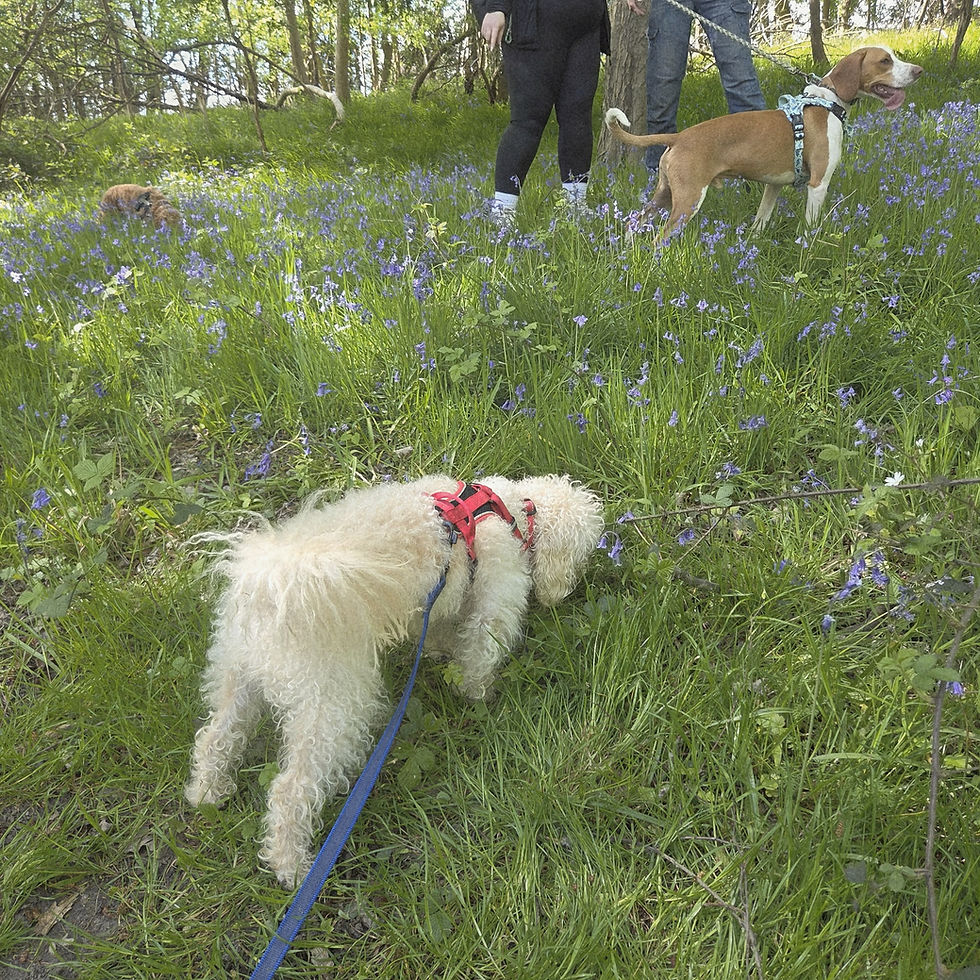
In the last blog, we looked at why some dogs seem to go at 100mph all the time, and how the issue often isn’t that they have too much energy, but that their arousal levels are too high.
If your dog struggles to switch off, gets overexcited on walks, or finds it hard to listen (or take food) outside, this blog will really help you!
Meeting our dogs needs
When we think about meeting our dog’s needs, we often focus on high energy walks, playing with other dogs or chasing a ball. While physical exercise is important, it’s only one part of the picture. Dogs also have a strong need to use their brains, and we can allow them more opportunity to do this by facilitating more time to carry out natural behaviours like:
Sniffing
Searching
Problem solving
Exploring
When these needs aren’t met, dogs will often find their own ways to release that energy. This is often when you see more behaviours like excessive barking, jumping, over excitement and even destructive behaviour at times. This is where mental enrichment comes into a league of its own!
Sniffing is a super power!
One of the most effective (and simple) ways to help your dog regulate themselves is through sniffing. Sniffing taps into your dog’s natural “seeking system”—the part of the brain linked to curiosity, exploration and reward. When dogs are given the opportunity to sniff and search, it can:
Help lower arousal levels
Encourage calmer behaviour
Provide mental fulfilment
Give them an appropriate outlet for their energy
This is why dogs often seem more settled after a slow, sniffy walk than after a fast-paced one. There are many easy and cheap ways you can provide your dog with loads of enrichment at home. Here are a few simple ideas:
Food Scattering
Instead of feeding from a bowl, scatter your dog’s food in the grass or around the house and let them search for it. If your dog eats wet food, put it in a lick mat, lick bowl or toppl. Having to work hard to lick the food out will activate the seeking system. In fact, anything that involves licking, sniffing or chewing will do the trick.
“Find It” Games
Hide small amounts of food or toys and encourage your dog to go and find them.
Box searches
Put treats in old cardboard boxes and fill with household junk (toilet roll or kitchen roll holders, egg cartons, rolled up paper etc.) to create “treasure hunts” for your dog.
Snuffle Mats or Puzzle Toys
These can be useful, but don’t feel you need to buy lots of equipment—simple is often just as effective. If you have a dog who is likely to eat the snuffle ball rather than the treats, think about hiding treats in something natural like a head of lettuce or cabbage so if they eat it they are just adding to their 5 a day!
Use it on your walks
You can also bring this into your walks. Rather than focusing on walking for miles, try:
Scattering food in the grass
Hiding treats in nooks and crannies on trees or logs
Letting your dog take the lead (safely) and explore
These activities will help lower your dog’s arousal very quickly. They are also such a great way to really strengthen the bond between you and your dog.
Why this is perfect for adolescents
If your dog is in that teenage phase (roughly 6–18 months), enrichment can be a real game changer. Because at this age dogs struggle with impulse control and get bored easily, we need to add lots of brain training enrichment. Giving them appropriate outlets like scentwork helps channel all of that energy into something productive, rather than letting it spill out into unwanted behaviours.
In summary
Don’t feel like you have to walk for longer or throw the ball further for your dog. By slowing down and allowing them to do what comes so naturally to them, you are actually likely to see:
Better focus
Calmer behaviour
Improved ability to listen
A more settled dog overall
Coming Next…
In the next blog, we’re going to look at how movement-based activities (like using natural obstacles on walks) can build confidence, focus and communication with your dog.
If you’d like help with your dog, I run training walks and one-to-one sessions in Romford, Essex and surrounding areas. Feel free to get in touch or keep an eye out for upcoming events.


Comments